Capabilities | Data, AI, Cloud, Applications, Advisory | Infoseer Consulting

What we do, and the order it usually happens in

Most clients start with one problem. Each piece tends to make the next one easier, which is why the list below is roughly the order things happen in. You do not have to do all of it.

01 Reporting and dashboards 02 Automating manual work 03 Cloud setup and migration 04 Business apps and integrations 05 Planning and training

01 · Usually the starting point

Reporting and dashboards

One set of numbers, refreshed on schedule, that every team can defend in a meeting.

For: businesses where reporting is assembled by hand each week, where teams disagree about which figure is correct, or where the data needed for a decision sits in three systems that do not connect.

What you end up with

  • Weekly reporting effort reduced to a scheduled refresh
  • A single governed data model behind every report
  • Role-based views for owners, managers, and analysts
  • Forecasts for revenue, demand, and churn built on your history
  1. Step 1

    Audit sources and document how data moves today

  2. Step 2

    Model the data once, in Fabric or Azure SQL

  3. Step 3

    Build reports in Power BI against that model

  4. Step 4

    Automate refresh, then train the people who use it

One model, not one model per report Illustrative structure
One governed data model feeding every reportSource systems on the left feed a single semantic model, drawn as a fact table surrounded by date, customer, product and branch dimensions. Executive, finance and operations views all read from that one model. Source systems One governed model What people open ERP CRM Point of sale Spreadsheets scheduled refresh Semantic model one definition of each metric, built once Date Customer Product Branch FACT · Sales one row per order line Row-level security applied here, once, not report by report Executive view revenue, margin, cash Finance view ageing, collections, spend Operations view fulfilment and stock
Every report reads the same model, so two teams cannot arrive at two different revenue figures. Security and metric definitions are set in one place.
Discuss a data engagement First dashboard live in one to four weeks

02 · Once reporting is reliable

Automating manual work

AI applied to specific, measurable work. We pick one process, measure what it costs today, and only keep what beats that baseline.

Assistants grounded in your documents

Staff ask a question in plain language and get an answer drawn from your own policies, contracts, and manuals, with the source cited so it can be checked.

Suits: teams answering the same internal questions repeatedly.

Document intelligence

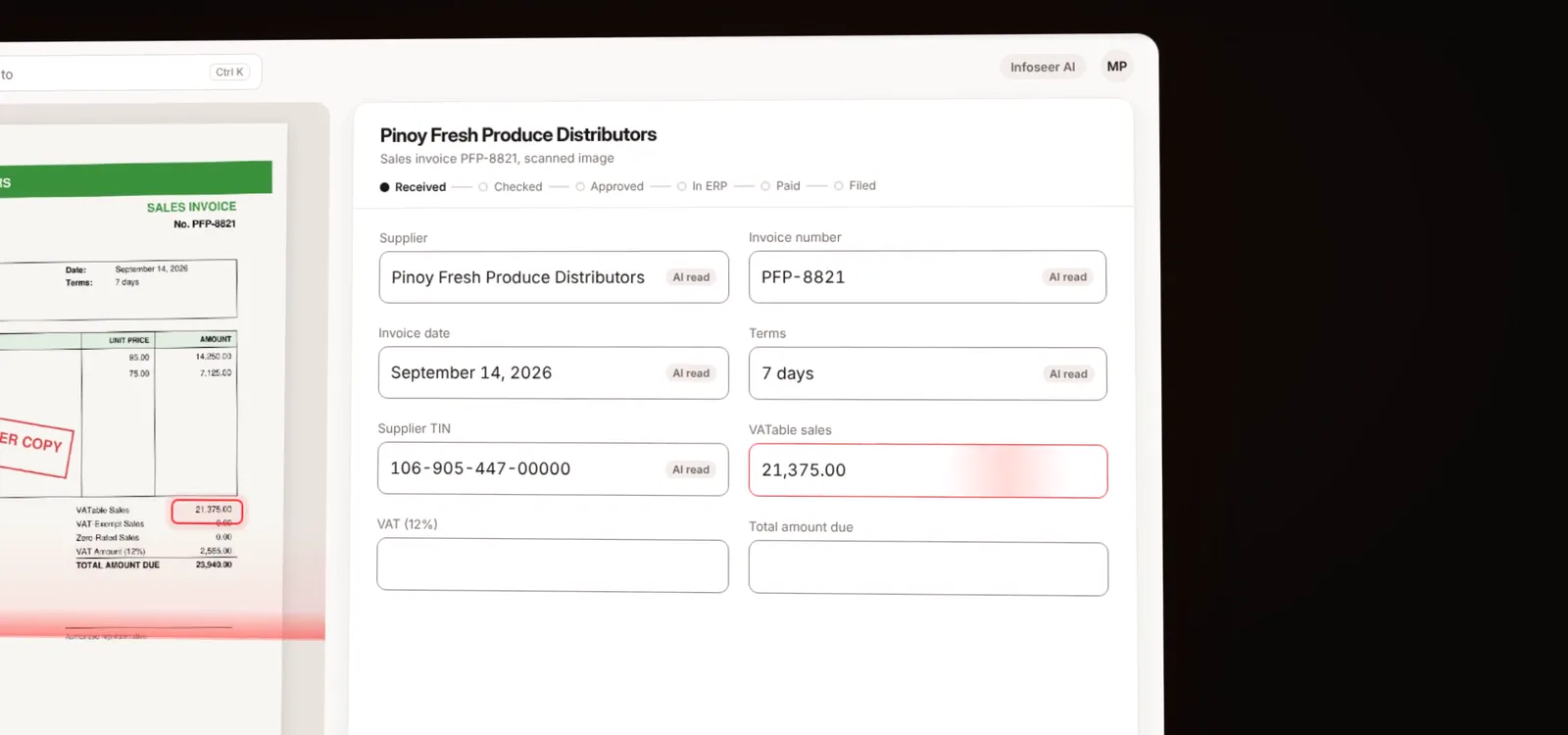
Invoices, application forms, receipts, and contracts read automatically, with the extracted fields validated and routed into the system that needs them.

Suits: high-volume paperwork currently keyed in by hand.

Workflow automation

Approvals, reminders, and handoffs that run on their own, with every automated action logged and a human review step kept where money or compliance is involved.

Suits: processes currently chased over email and chat.

One invoice, end to end Illustrative thresholds
How a supplier invoice moves through document intelligenceAn invoice arrives by email or scan. Fields are extracted with a confidence score each. Validation checks totals, tax, purchase order match and duplicates. Anything above threshold posts straight to the ERP; anything flagged goes to a human review queue. All of it is logged. Invoice arrives email · PDF · scan Fields read confidence Supplier 0.99 Invoice number 0.98 Amount due 0.97 PO match 0.71 anything under 0.95 is not posted Validate totals, tax, PO match, duplicate check Posted to your ERP no keying, no re-checking Human review queue one screen, the flag already on it Every extraction, decision, and human correction is written to an audit log
The threshold is the point of the design. The model does not decide what it is unsure about — it hands that to a person, with the reason attached.
Discuss an AI engagement Pilots run two to six weeks, evaluated against real cases before rollout

03 · When the foundation needs work

Cloud setup and migration

Infrastructure decided deliberately, so cost, access, and recovery are not discovered during an incident.

For: businesses moving off ageing servers, running cloud services that grew without a plan, or preparing for an audit that will ask how systems are secured and recovered.

Discuss a cloud engagement
  1. 01

    Assess

    Current workloads, dependencies, and constraints, written down rather than assumed.

  2. 02

    Design the landing zone

    Identity, network, and policy agreed before anything moves.

  3. 03

    Migrate in waves

    Sequenced by risk, with a rollback defined for each wave.

  4. 04

    Hand over

    Runbooks, monitoring, cost reporting by workload, and a tested recovery procedure.

What gets decided before anything moves Illustrative landing zone
The shape of a landing zoneEntra ID sits above a management group where policy, RBAC and cost tags are applied. Inside it, a hub network holding firewall, VPN, DNS and bastion peers to a production spoke and a non-production spoke, alongside a guardrails panel. Microsoft Entra ID — identity, groups, and conditional access Management group policy, RBAC, and cost tags set once here, inherited by everything below Hub network Firewall VPN or ExpressRoute Private DNS Bastion access shared services live once Production spoke app tier · data tier · Key Vault change-controlled, monitored Non-production spoke dev and test, the same shape cheaper tiers, no live data peering peering Guardrails Azure Policy at scope RBAC by group, not person Cost tags per workload A restore you have watched agreed before anything moves Handover pack: runbooks, alert rules, a cost report broken down by workload, and a recovery test your team has run themselves
Cost, access, and recovery are properties of this diagram, not things discovered during an incident. The shape is agreed in the design stage.

04 · When a process outgrows spreadsheets

Business apps and integrations

Applications for the processes your business runs on, and integrations that end manual re-entry between systems. The first decision is usually which build route to take.

Low-code on Power Platform

Faster to build, easier for your team to change later.

Right when

  • The process is internal with clear rules
  • Volume is moderate
  • Requirements change often
  • Field staff need mobile capture

Custom build

More effort up front, and no ceiling on what it can do.

Right when

  • Customers or the public will use it
  • Transaction volume is heavy
  • Logic must be tested rigorously
  • It becomes part of the product you sell

Integration only

Keep the systems you have, and make them exchange data.

Right when

  • Existing software covers most of the need
  • Staff copy data between two systems
  • The same record exists in several places
  • Errors come from re-entry, not the software
Where the same record lives Illustrative integration map
How systems stay in step without re-entrySix business systems arranged around a central integration layer. Customer, order and stock records flow in from CRM, the online store and the warehouse; invoice, employee and metric records flow out to accounting, payroll and the reporting model. Sales CRM leads, accounts, deals Online store orders and payments Warehouse and POS stock and movements ERP and accounting invoices, journals Payroll and HR people, cost centres Reporting model one governed copy Integration layer Power Automate · Functions retries and error alerts built in customer order stock invoice employee metrics One system owns each field. Every other system subscribes, so the change is made once and nobody re-keys it.
If staff copy a record from one screen into another, that is a line missing from this diagram. Integration-only engagements add the lines and leave the systems alone.
Discuss an application build We recommend the route in the proposal, with the reasoning written down

05 · Instead of, or alongside, delivery

Planning and training

A clear read on where you stand, a sequence worth funding, and a team able to run what gets built. This is the engagement to choose if you want internal ownership rather than a permanent vendor.

Discuss an assessment
Assessment
A written read on systems, data quality, and capability gaps, based on interviews with the people who own the processes.
Roadmap
What to do in what order, sequenced by value and dependency, with effort estimates against each item.
Governance model
Named owners for each data set, agreed metric definitions, and a documented access policy.
Training
Hands-on workshops in Power BI, data modelling, and AI tooling, run against your own data rather than sample files.
The roadmap is the deliverable Illustrative sequence
What a roadmap deliverable looks likeA four-quarter chart. Assessment runs in quarter one, the governance model spans quarters one and two, delivery spans two and three, training spans three and four, and from quarter four the client team runs it with advisory support. Quarter 1 Quarter 2 Quarter 3 Quarter 4 Assessment Governance model First delivery, then the next Training and enablement Your team runs it, we advise Illustrative sequence. Yours is ordered by value and dependency, with an effort estimate written against each item.
The point of an assessment is this picture: what to do, in what order, and what you stop paying us for once your team can run it.

What this looks like in practice

Three engagements, described end to end

Representative scopes rather than named clients, so you can see how a request turns into a deliverable and a timeline.

Technology company · 4 weeks

Collections reporting, from six spreadsheets to one dashboard

Starting point
Each branch sent a weekly collection file. Consolidation took a full day and the totals rarely matched the ledger.
Delivered
One combined view of product, subscription, support, and delivery data, a dashboard that refreshes every morning, and a short list of records that need a person to check them.
Result
Consolidation effort removed, overdue items visible the next morning instead of the following week.

Distribution business · 5 weeks

Supplier invoices read and routed automatically

Starting point
Two staff keyed supplier invoices into the accounting system, and approvals were chased over email.
Delivered
Software that reads each invoice, checks it against the purchase order, and sends it to the right person to approve, with a record of who approved what.
Result
Manual keying limited to exceptions, with a reviewer confirming anything above the agreed threshold.

Software firm · 3 weeks

Revenue and cloud cost in one view

Starting point
Billing sat in one tool, cloud spend in another, and nobody could say which customers were unprofitable.
Delivered
Billing, usage, and cloud cost brought together in one view, showing the margin on each customer and how recurring revenue moved month to month.
Result
Pricing conversations grounded in cost to serve, with the loss-making accounts named.

These are representative engagement scopes, not accounts of named client projects. Specific references are available on request during a discovery call.

Common questions

Choosing a capability

See how delivery runs on the approach page, or the sector detail in industries.

Which capability should we start with?

Most engagements start with data and analytics, because a reliable set of numbers is what the other four areas end up depending on. If reporting is already sound, the usual second step is AI and automation on a single high-volume process.

How does Infoseer keep AI projects safe to deploy?

Each system is scoped to a defined document set or process, deployed inside your Microsoft tenant, and given access controls that follow your existing identity groups. Automated actions are logged and reviewable.

When is a low-code application the right choice?

Low-code on Power Platform fits internal processes with clear rules, moderate volume, and frequent change. Custom code is better for customer-facing systems, heavy transaction volume, or logic that must be tested rigorously.

Can Infoseer train our internal team instead of running the work?

Yes. Enablement engagements cover assessments, roadmaps, governance models, and hands-on training in Power BI, data modelling, and AI tooling, so an internal team can own delivery afterwards.

Not sure which capability you need?

Describe the problem in plain terms on a 30 minute call. If the answer is a different firm, we will say so.